

Description
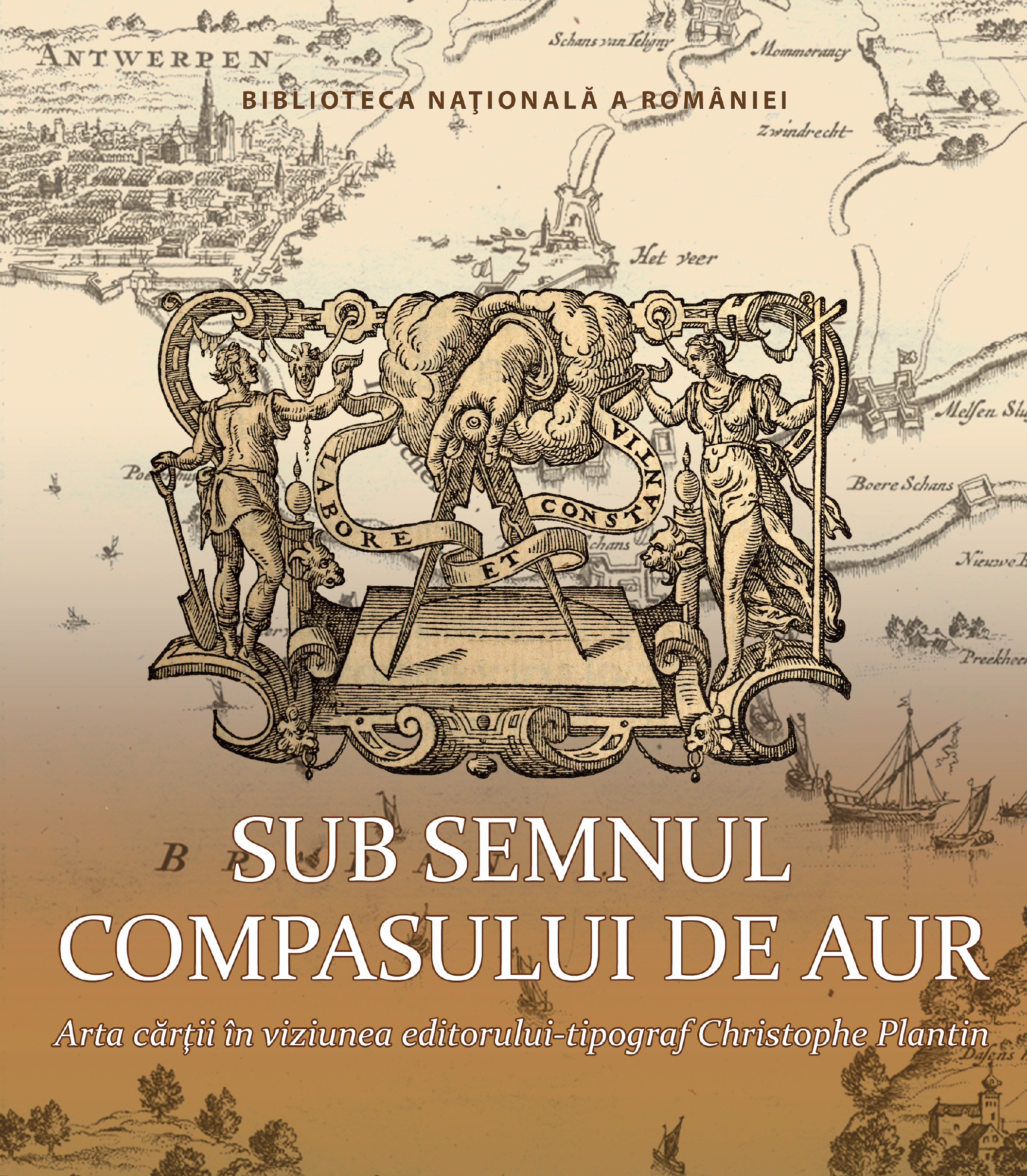
The catalogue “Sub semnul Compasului de Aur: arta cărţii în viziunea editorului-tipograf Christophe Plantin” is designed to highlight treasures preserved within the Special Collections of the National Library of Romania, offering a comprehensive overview of a corpus of printed works of undeniable documentary importance and bibliophilic value.
Works published more than four centuries ago, mainly in Antwerp, are brought to the public’s attention. Dubbed the “Athens of the Low Countries” during the Renaissance, this significant Flemish cultural and economic center—the true capital of these lands at the time in terms of trade and crafts, particularly printing—became, starting in 1555, the hearth of the prodigious Officina Plantiniana, founded by the brilliant bookbinder, publisher, and printer Christophe Plantin (1520–1589). Born in the Loire Valley, he had been carried to the Flemish lands by the powerful magnetism exerted on all those in search of progress by the port city of Antwerp, which at that time rivalled metropolises such as Venice or Lyon. The Officina Plantiniana experienced an impressive boom, reflected in the large volume of notable typographical creations issued under the unmistakable emblem of the Golden Compass and under the influence of the Latin motto “Labore et Constantia”, an expression of the vocation and humanist views of publisher-printer Christophe Plantin. Enjoying the appreciation of successive generations of readers and collectors, the Plantinian editions have crossed the centuries as messengers of the human society from which they emerged. At the same time, they reflect a high degree of circulation achieved throughout the world, a fact attested by the frequent handwritten annotations and ownership marks carried by these volumes.
The present catalogue aims to outline the art of Plantinian printing through the thirty-six editions presented, works of remarkable accuracy, featuring elegant typography and exceptional iconography, while reconstructing, as far as possible, the atmosphere of cultural effervescence in the second half of the 16th century in which they were created. As such, historiographical assessments are provided, alongside information gathered from bibliographical and documentary research, highlighting the specific
characteristics of the editions and individual copies, as well as their bibliophilic elements. Details are also highlighted regarding the critical and iconographic apparatus, the contributions of the personalities involved in the creation of these books, the relationships and intellectual geography that define the activity of Christophe Plantin’s printing house.
The works stand out as editio princeps, first editions, some illustrated or published under the care of renowned humanist scholars such as Justus Lipsius, Arias Montanus, Fulvius Ursinus, or Victor Giselinus.
The collection includes, among others, the emblem books of Joannes Sambucus and Hadrianus Junius, the botanical album belonging to Matthaeus Lobelius, the famous collection of classical legal texts and imperial constitutions “Corpus Juris Civilis”, some of the humanistic works signed by the Flemish scholar Justus Lipsius, and so forth, all of which clearly contribute to the prestige of the collections of the National Library of Romania.







Reviews
There are no reviews yet.